Why PRVs and Control Valves Become Noisy — and How Acoustic Insulation for Valves Reduces Industrial Noise
Excessive noise from pressure reducing valves (PRVs) and control valves is a common challenge in industrial facilities. In many cases, this noise is accepted as normal operation — yet excessive sound levels can negatively affect working conditions, communication, and overall comfort around critical equipment.
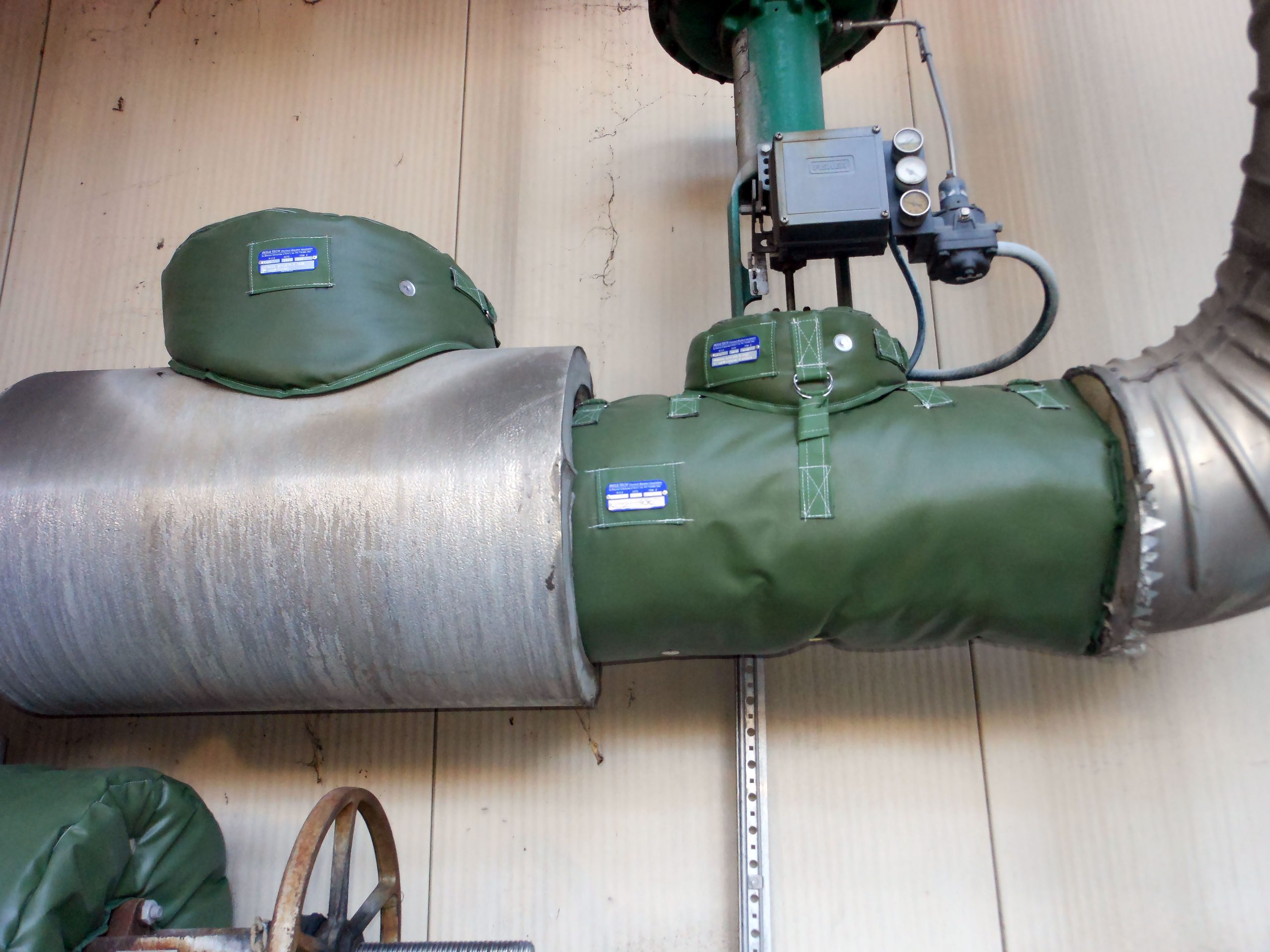
Because these valves regulate pressure and flow, noise generation is often unavoidable. However, properly engineered acoustic insulation, including removable acoustic blanket insulation and acoustic jacket insulation, provides a practical and effective way to achieve significant noise reduction without modifying the process itself. In many industrial applications, acoustic insulation for valves provides a practical and effective way to control excessive noise without modifying the process.
Why PRVs and Control Valves Generate Noise
PRVs and control valves are among the most frequent sources of continuous noise in industrial piping systems. Unlike passive fittings, these valves intentionally create pressure drops to regulate flow and maintain process conditions.
When fluid passes through a restricted valve opening, pressure energy is partially converted into:
• high-velocity flow • turbulence • vibration • acoustic energy
In steam, gas, and high-pressure liquid systems, this energy conversion can generate substantial airborne and structure-borne noise.
Typical contributing factors include:
• Large pressure differentials • High flow velocities • Turbulence during throttling • Cavitation or flashing in liquid systems • Steam expansion and unstable flow conditions
As a result, PRVs and control valves often represent the dominant noise source in mechanical rooms and utility areas.
Why Valve Noise Should Not Be Ignored
Excessive valve noise affects not only comfort but also safety and operational performance. High ambient sound levels can lead to:
• Increased exposure to harmful noise • Communication difficulties near equipment • Operator fatigue and reduced concentration • Poor working conditions in confined spaces • Potential compliance concerns in noise-sensitive areas
Reducing ambient sound through effective noise insulation significantly improves the surrounding work environment and operator comfort.
Traditional Noise Reduction Approaches
Engineers may consider several methods to reduce valve noise, such as:
Low-noise valve trims
Multi-stage pressure reduction
Silencers or diffusers
System or piping modifications
While these solutions can be effective, they often involve higher investment costs, engineering redesign, or production downtime. For existing installations, external noise insulation solutions are often more practical.
Acoustic Insulation for Valves in Industrial Applications as a Practical Solution
External acoustic blanket insulation offers a straightforward and efficient approach to industrial noise reduction. Instead of modifying the valve internals or piping layout, acoustic insulation works externally by controlling how sound energy propagates into the surrounding environment.
Acoustic blanket insulation and acoustic jacket insulation help reduce harmful airborne and structure-borne noise generated by pressure and flow-rate changes inside PRVs and control valves. By lowering ambient sound levels, they improve the surrounding work environment — especially in sensitive locations such as mechanical rooms, utility corridors, and confined spaces.
Key mechanisms include:
• Absorbing sound energy • Blocking airborne noise transmission • Reducing reflected noise around equipment
Because installation is external, acoustic jackets can usually be installed quickly with minimal operational disruption.
How Acoustic Jacket Insulation Works
Industrial acoustic insulation systems are typically designed as multi-layer constructions that combine durability and acoustic performance:
✔ Durable outer layer resistant to industrial conditions ✔ High-density acoustic core optimized for sound absorption ✔ Reinforced seams and closures for long-term reliability
Proper fit is essential. Custom-designed acoustic jacket insulation minimizes sound leakage and ensures consistent acoustic performance while allowing easy removal for maintenance access.
Typical Noise Reduction Performance
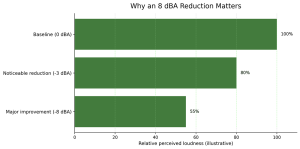
Depending on valve design and operating conditions, acoustic blanket insulation typically provides an overall noise reduction of approximately 8 dBA on average.
Although this value may appear modest, an 8 dBA reduction represents a substantial perceived decrease in loudness due to the logarithmic nature of the decibel scale.
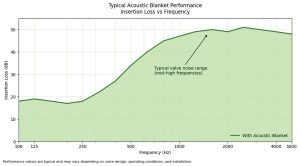
The performance graph below illustrates typical insertion loss across different frequencies, showing how acoustic insulation performs particularly well in the mid- to high-frequency range where valve noise is most dominant.
Practical Example
In a food processing facility, excessive noise from a steam pressure control valve created uncomfortable working conditions for nearby operators. After installing removable acoustic blanket insulation, ambient sound levels were reduced by approximately 8 dBA, resulting in a measurable reduction in ambient noise levels and improved operator comfort.
Conclusion
Noise generated by PRVs and control valves is a natural result of pressure and flow regulation. However, excessive noise levels do not have to be accepted as unavoidable.
Properly designed acoustic insulation, including removable acoustic blanket insulation and acoustic jacket insulation, provides an effective and practical solution for industrial noise reduction. By reducing ambient noise levels around critical equipment, facilities can significantly improve working conditions without major system modifications.
Combined Benefits in High-Temperature Applications
In high-temperature systems, acoustic insulation is often combined with thermal insulation in a single removable package. In these applications, the combined benefits of noise control, heat loss reduction, and hot surface protection can result in a typical payback period of approximately 6–12 months, depending on operating conditions.
This allows facilities to address multiple operational challenges — noise control, heat loss reduction, and hot surface protection — within a single integrated solution.
With nearly four decades of experience, we manufacture precision-sized industrial insulation, which we offer for a wide range of applications in many areas of industry. You can read more about this in the PRODUCTS / INDUSTRIES section of our website.
See some more example projects on the ENERGY SAVINGS subpage, where the rate of return on investment is also quantified.
If we can help you, please contact us or request a free TAS Energy Audit today.
Decarbonization in industry increasingly depends on steam system energy efficiency, as rising energy costs and regulatory pressure reshape how energy is used worldwide. While much of the discussion focuses on new technologies and major capital investments, one of the most effective decarbonization opportunities is often overlooked:improving steam system energy efficiency by reducing existing energy losses. […]
In chemical processing facilities, insulation must provide more than basic heat loss reduction. Chemical processing insulation plays a critical role not only in improving thermal efficiency, but also in protecting personnel, equipment, and surrounding infrastructure when hazardous or aggressive process media are involved. This project demonstrates how custom removable insulation jackets can deliver both safety […]
Outdoor steam valves, flanges, and other steam fittings on industrial systems can lose significant amounts of heat throughout the year. Under typical conditions, insulating these components can pay for itself within 4–8 months. However, when winter arrives and ambient temperatures drop, heat loss increases even more — often shortening the payback period so much that […]