Removable insulation jackets and blankets are widely used to reduce heat loss from steam fittings and other process equipment. In most industrial environments, the starting questions are relatively straightforward: What is the operating temperature? How much insulation is required? Is the insulation jacket removable and reusable?
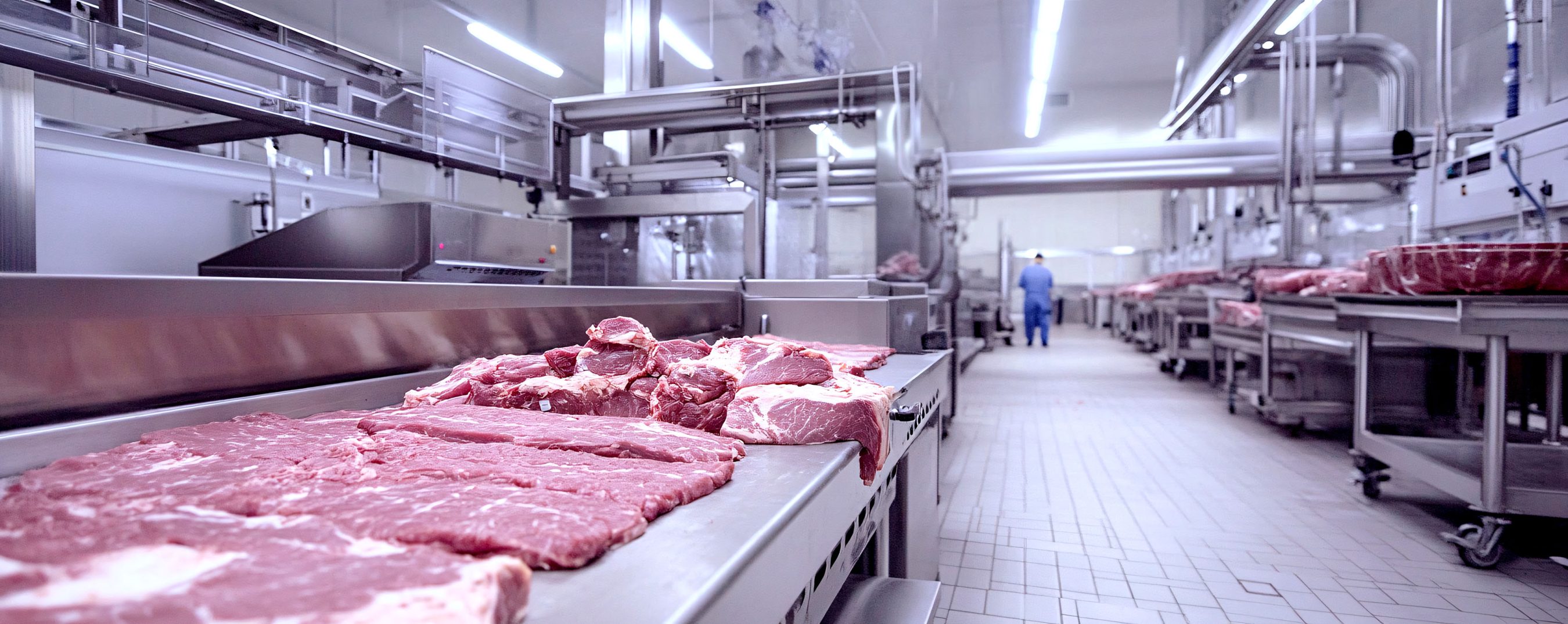
In food and beverage production areas, this is not enough.
An insulation blanket may perform perfectly well thermally and still be unsuitable for the environment in which it is installed.
Where food products are exposed, equipment is frequently washed down, or aggressive cleaning and sanitation chemicals are used, the insulation system itself must be considered as part of the hygienic environment
During energy surveys in food-processing facilities, it is not unusual to find steam valves, flanges, strainers and other process fittings and equipment completely uninsulated.
This does not necessarily mean that the facility is unaware of the energy loss.
In some cases, the decision is intentional.
Facility and food-safety teams may be concerned that conventional insulation could become damaged, absorb moisture, trap food residue or release loose insulation fibers close to the production process. Faced with a choice between reducing energy consumption and introducing a potential contamination risk, leaving the equipment uninsulated can appear to be the safer option.
Unfortunately, this can mean significant heat loss year after year, higher ambient temperatures around production equipment and unnecessarily hot surfaces for employees working nearby.
The answer is not simply to install a standard industrial removable insulation blanket.
The answer is to design the insulation system specifically for the environment.
One of the most common mistakes when specifying removable insulation covers is focusing primarily on maximum service temperature.
Temperature is obviously important. But in a food-processing environment, we believe the specification should go much further.
The complete insulation system should be evaluated for:
The correct reusable insulation system therefore depends not only on how hot the equipment is, but also on where the equipment is located and how that area is operated and cleaned.
A removable insulation blanket designed for a boiler room and an insulation jacket installed next to an open food-production line should not automatically be treated as the same product. Even within a single facility, a project often requires several distinct material specifications tailored to the specific operational and hygienic needs of each area.
For example, silicone-coated fiberglass fabrics are commonly used for industrial removable insulation. They can provide excellent performance in appropriate applications.
However, a material that works successfully in a conventional mechanical room may not necessarily be the best choice in an area subjected to intensive washdown, cleaning chemicals and strict foreign-body controls.
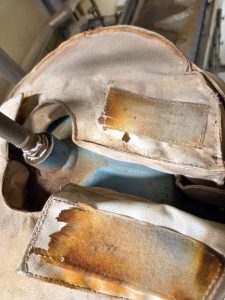
Repeated environmental exposure can eventually damage an unsuitable outer covering. Once a coated fabric deteriorates sufficiently, its underlying reinforcement can become exposed. In a normal industrial environment this may primarily become a maintenance issue. Near exposed food production, deterioration and loose material can represent an additional contamination concern.
The same principle applies to every component of the blanket. In this case a hygienic jacket insulation design is required.
The main fabric receives most of the attention when insulation is specified, but an insulation blanket consists of much more than its outer cover.
Fasteners, straps, identification tags, edge protection, thread and closure systems all need to be considered.
Hook-and-loop fasteners may be convenient in many industrial applications, but they require particular consideration in hygienically sensitive food-processing areas. They can retain dirt and moisture, can be difficult to clean thoroughly, and may deteriorate prematurely when exposed to heat, repeated washdown or aggressive cleaning conditions. If damaged or degraded, components of the fastening system may detach, creating an unnecessary foreign-body contamination risk.
For this reason, TAS generally avoids hook-and-loop closures in these applications and uses durable stainless-steel fastening systems instead.
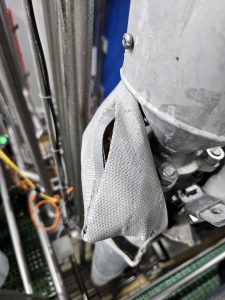
Edges deserve particular attention as well. An exposed or poorly protected edge can become the starting point for premature deterioration. Protecting vulnerable areas of the blanket helps maintain the integrity of the insulation system throughout repeated handling, cleaning, removal and reinstallation.
Hygienic design
is only as strong
as its weakest detail.
A close-fitting insulation blanket reduces exposed hot surfaces and unnecessary heat loss.
In food-processing areas, however, accurate design has another important function: Loose blankets, excessive overlaps and poorly positioned seams can create pockets and ledges where water, dirt or food residue may accumulate.
This is why we believe insulation for hygienically sensitive applications should be accurately designed around the actual geometry of the valve, flange or equipment.
The objective is not simply to make a blanket that “fits.”
The objective is to minimize unnecessary gaps, folds, cavities and collection points while maintaining the removability required for inspection and maintenance.
A food-production environment should therefore be evaluated before the blanket construction is selected.
Is the area wet-cleaned or dry-cleaned?
How frequently is it washed?
Which cleaning and sanitation chemicals are used?
Can the insulation be directly exposed to high-pressure water?
Could food product splash onto the blanket?
Is the equipment located above or immediately adjacent to exposed product?
How frequently must the insulation be removed for maintenance?
These questions can be just as important as operating temperature.
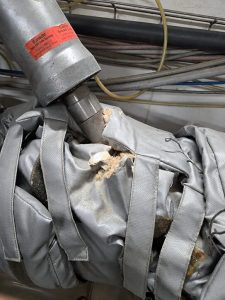
A blanket is only as durable as its seams are: The sewing thread and simple sewn edge are often among the most vulnerable components of removable insulation. Exposure to heat, moisture, cleaning chemicals and repeated washdown can cause unsuitable thread to deteriorate prematurely. If a seam opens, the internal insulation may become exposed, potentially releasing fibers and creating a foreign-body contamination risk. For hygienically sensitive applications, appropriate thread selection and reinforced, double-sewn seams provide an additional level of protection.
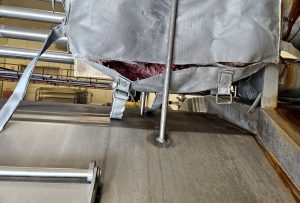
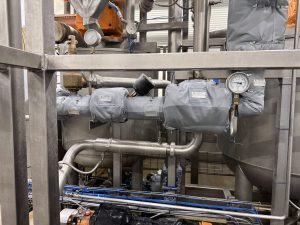
Images like this illustrate why material selection should consider the complete operating environment.
The question is whether the insulation system remains structurally intact and safe for the surrounding production area over time.
Has the external surface started deteriorating? Are fibers becoming exposed? Can damaged components detach? Are the seams trapping contamination? Is moisture entering the insulation? Can the blanket still be cleaned effectively?
If the answer to these questions is no longer satisfactory, the insulation itself can become an unnecessary maintenance and hygiene concern.
This is also why simply replacing a failed blanket with another blanket of the same conventional construction may not solve the underlying problem.
The environment needs to be considered first.
At TAS Blanket Insulation, we treat food-processing applications differently from standard industrial applications. We do not believe that selecting a material according to temperature alone is sufficient.
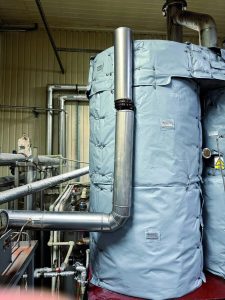
For hygienically sensitive applications, our focus is on selecting a construction appropriate for the actual environment and designing the complete system to minimize potential contamination risks while providing long-term thermal performance.
Depending on the application, this means considering:
Non-shedding and contained construction
The system is designed to prevent exposed or migrating insulation fibers during normal service.
Resistance to moisture and washdown conditions
Materials are selected with the actual washdown environment, humidity and cleaning regime in mind.
Chemical resistance
Where cleaning or sanitation chemicals are present, their compatibility with the blanket construction must be considered.
Accurate design
Our blankets are engineered to closely follow the geometry of the insulated equipment, helping minimize unnecessary gaps, pockets and areas where dirt or product residue could accumulate.
 Durable edge construction
Vulnerable edges are protected to help prevent premature deterioration during service, cleaning and repeated handling.
Stainless-steel components
Vulnerable hook-and-loop closures are replaced with corrosion-resistant stainless-steel fasteners and identification tags.
Removability and reusability
The insulation remains accessible for maintenance and inspection and can be removed and reinstalled instead of being destroyed every time the equipment requires servicing.
The energy-saving opportunity can be substantial. A single uninsulated fitting may appear insignificant, but a facility can contain hundreds of fittings and other process equipment. Together, these surfaces can represent considerable continuous heat loss.
Yet energy efficiency should never be pursued at the expense of food safety.
This is why projects in production areas require additional care.
In our view, the correct question is not:
“Can this material withstand the temperature?”
It is:
“Can this complete insulation system withstand the temperature, cleaning regime and production environment throughout its expected service life without creating unnecessary hygiene or contamination risks?”
Those are two very different questions.
And in food & beverage processing, the difference matters.

Engineering insulation for the environment
Learn more about how removable and reusable insulation can improve safety and efficiency across your steam system.
Learn more about how precision-engineered blanket insulation improves thermal performance and maintenance efficiency for complex industrial equipment in our related technical articles.
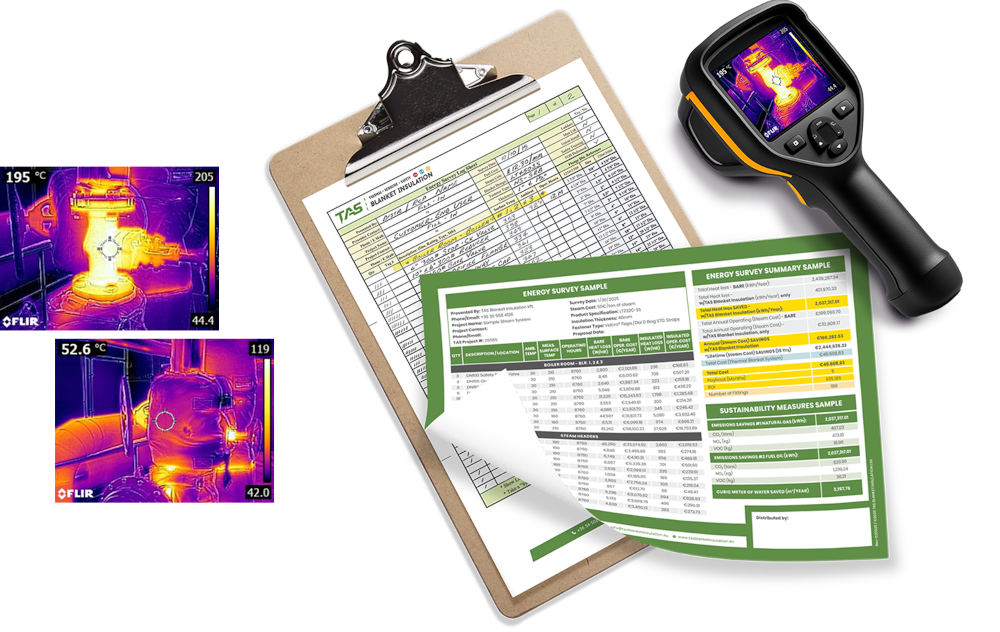
If we can assist you, please contact us or request a free TAS Energy Audit today.
“Quality, Sustainability, Energy Efficiency”





tonS of CO2 Emissions
reduced